Showing posts with label Politics. Show all posts

Thursday, October 13, 2011

OWS 4: OWS and the Tea Party (Conclusion)


At one point, I watched as a news crew interviewed Michael.  They wanted to hear about the anger we all felt, but Michael insisted there was no anger, and surprisingly, I think he was right.  Sure, people are unhappy, but it didn’t feel that way down there.  It felt optimistic, hopeful, and even joyous.  One fifty year old woman I spoke to, a professional who had lost everything when the housing bubble crashed, said that these days she felt safer and happier at the protest than any elsewhere.  Michael said he saw very little anger, but that wasn’t what the news company wanted to hear.  The reporter spoke to her boss and she was told to cancel the interview.  No one wanted to see something about hopeful, positive protesters.  They wanted anger and arrests, pepper-spray and dirty hippies.  As the news shows, if you look for something, you’ll find it, and I’m sure this reporter did too.
            I did see one bit of anger, but it wasn’t from the protesters, but from a ‘tourist’.  A angry man in a suit ended up shouting at the man with the detailed banking proposal on his poster-board sign.  “Where were you when the Tea Party was marching?” he asked, disgusted.  I was proud that the protesters stayed rather civil with him, although he was far more aggressive in his accusations.  Still, he did have a point.  How was this different?
            I saw the above exchange in the first hour I was there, but that moment stuck with me longer than the rest.  The guy had a point.  I thought back to when I first heard about the Tea Party, and I remember being briefly sympathetic.  But it wasn’t long before I scorned them right along with the rest of my liberal friends.  I tried to remember what changed, and social issues were the most obvious thing that caused me to write them off as misguided.  However, other than the stances on social issues (in which OWS comes clearly down in favor of progressive policies), the two movements have a lot in common.  Both clearly stem from a recognition that government by the people for the people is falling apart and that the system has failed too many.  Both were initially popular movements made of regular people.  The Tea Party these days seems to have been mostly subsumed into the Republican establishment, with strong corporate backing, but OWS is still young and may soon find itself in a similar situation.
            I did see one important difference between OWS and the Tea Party – philosophy of government.  The Tea Party views government as an inherent problem; big government is inherently inefficient and wasteful, and private enterprise is efficient and effective.  Government is the problem, not the solution.  OWS seems to agree that government is broken, but it believes that corporate culture did the breaking.  From that point of view, government by the people is a good thing, but impossible in our current climate.  Government isn’t inherently the problem, but is because it’s bought and paid for.  Fix the corporate climate, and government becomes a force for good.
            I see both sides of this issue. I agree that government bureaucracy is wasteful and inefficient, but I believe that this is a matter of scale – look at the sheer waste of government dollars paid to private companies in Iraq and Afghanistan.  However, I (and most of the people at OWS I believe) would rather have a wasteful government healthcare (just one example) than corporate healthcare and insurance.  Why?  Because the government program’s purpose is to take care of it’s citizen’s health.  That’s the bottom line.  The insurance companies bottom line is on their financial sheet.  They are responsible to shareholders, not their clients and it is in their best interest to NOT pay for medical care.  Beyond that, I’d rather have billions of dollars wasted on doctors and medicine than billions in dollars in profit for executives who try to cut costs and deny coverage whenever possible.  Honestly, when it comes to health, I view ridiculous insurance profits as more inexcusable than government waste. But that’s just my own pet issue.
            I’ve heard many people who support the Tea Party exclaiming that OWS is anti-American and anti-capitalist.  No doubt that there are many who could be called anti-capitalist in the movement (or communist, socialist, or anarchist), but I’m not sure it’s as broad as the news would have you believe.  Many people think they’re anti-capitalist, but are actually anti-something else, as they don’t have much of an understanding of capitalism.  I spoke to one man in his 60s, a salesman, who put it beautifully:  “I’m a capitalist,” he said with a note of pride, “I’ve never had a cushy salary job, or paid vacation, or anything, and I’ve worked 33 years in this job.”  What was he against?  “Greed,” he said simply, adding that capitalism is all about making a good product and selling it honestly.  He complained that instead these companies cheat, steal and lie, and then buy political power to protect themselves and insure monopolies. 
            There is a difference between capitalism and plutocracy.  The later encourages monopolies of a few rich individuals and companies.  The number of major banks in this country keeps shrinking as the biggest banks gobble them up.  Competition against them is impossible, just like it is among the telecoms, and big outlets like Walmart that routinely destroy small businesses and turn small towns into their personal fiefs.  Monopolies and plutocracies are anti-competition, and therefore anti-capitalist.  And of course, that makes them as un-American as can be. 
            But it was social issues that really turned me off the Tea Party: hostility to gay marriage, racism, and religious extremism of the Christian variety.  But seeing news coverage of OWS and comparing to the reality I saw with my own eyes, I have to wonder if I was misled.  I have no doubt that much of what scares me about the far right is present in the Tea Party, but I have to wonder if that’s just where the cameras were pointed, much like the young anarchist punks down at Liberty Park seem to get most of the attention from the media.  Clearly, OWS and the Tea Party have very different social values, but both are crying out for fairness, transparency, and accountability.  They identify different sources of the problem, and different solutions.  I still think the Tea Party’s anti-government philosophy and faith in an unregulated market is misguided, but OWS has plenty of its own problems.  But they have more in common – both are popular movements, drawing regular people who don’t actually know much about politics or policy, but see that this country is being taken for a ride.  I don’t think the Tea Partiers see things clearly, but neither do most people down at OWS.  When there’s so much emotion, how can anyone think clearly? Then again, no one elected them – it’s not their job nor responsibility to write laws.  Many have few resources (or none thanks to the job market), and few have much access to the political process beyond choosing the lesser of two evils and pulling a lever every couple of years.  But they know that something has to be done, and like me, they want to help make this country better.  In the final analysis, both the Tea Party and OWS are made up of patriots who disagree, but are patriots nonetheless.
            Protest actions and passive resistance don’t create laws, politicians do, but politicians feel social pressure acutely.  Social pressure works.  Egypt proved that, Martin Luther King Jr. proved that… hell, the Tea Party proved that, helping to steer the political dialogue of the 2010 elections in their favor.  OWS is not an organization, not really.  It’s not a political party.  It’s a symbol, and a powerful one at that, and people are responding.  As the night fell Friday night, I departed, tired, bewildered, yet energized.  Like others I talked to, I found the protest frustrating, inspiring, maddening, and uplifting, all at once.  Like any symbol, it means something slightly different to everyone who experiences it, but that is its power, its strength.  So bewildered was I that I had trouble finding the subway, despite having worked two blocks away from the park for over a year.  On the crowded subway, in the press of tired bodies heading home, I felt a strange sense of unity with the people on the train, even if they didn’t know it.  I looked around and realized that everyone I saw was part of the 99%.
            And so am I.
OWS 3: Analysis


If you’re looking for a 3rd party option for the next election, look elsewhere.  If you’re looking for a political action group, look elsewhere.  If you’re looking for a liberal Tea Party to help steer the democrats left, look elsewhere.  If you’re looking for a genuine popular movement, look no further. 
            The people of Occupy Wall St. are not pundits, politicians, or professional organizers.  They’re not funded by the Koch brothers or Warren Buffett for that matter.  It’s hokey to say it, but they’re ‘us’.  By which I mean, they’re regular folks, and I feel about them much as I do myself – I wouldn’t vote for them if they ran for office (I’d make a terrible President).  These are not policy makers, so don’t look for a new Banking Bill to be sent from Liberty Square to Congress.  More importantly, I think it would be wrong of us to expect that activists should be perfectly coherent in their demands or to make policy recommendations among protest signs and street theater.  Yet, these people do stand for something, even if only a few of them can articulate it well (ask yourself if your neighbors could do better).  There are as many ideas and opinions down there as there are people, but one idea seems to unite the rest symbolically: corporate greed is ruining our society. They might not be able to say exactly why that is, or quote figures from memory, but they recognize that something has gone wrong for 99% of us, and right for the 1% we’re holding up with our labor and taxes.  To one person, what’s most important is corporate blocking of significant health care reform, to another it’s about corporate sponsored warfare, and to yet another it’s about the numerous issues surrounding agricultural monopolies and genetic modification of food.  Those are just a few examples, but all tie back to the notion that our government isn’t protecting us from a greedy, powerful section of our society, labeled the 1%. 
            I spoke to one young woman who put it well.  I asked her what she hoped would come out of this, and her answer seems to be a common one among the activists.  “Nothing,” she said, but she didn’t mean it pessimistically.  “But it will bring energy to lots of organizations that already exist out there.”  She drew a diagram, a circle at center labeled OWS, and like spokes on a wheel she drew circles sprouting from OWS.  They were small, grassroots organizations, she said, fighting the various problems of our time (and seen as stemming from that same corporate culture of greed).  She labeled a few: education, poverty, and sustainability.  But I heard many others, and I began to see what may really be happening here.  I heard about banking reform, ending foreign wars, getting off oil, corporate accountability, loan forgiveness, healthcare, and many others.  It became clear to me that what united these people is the feeling of powerlessness, the feeling that the government has been bought and paid for, making the varied reforms I’d heard about seem impossible to implement against the pushback of billionaires. 

OWS 2: Getting Involved

After some initial conversations, I was introduced to the guy who had started the coaching table a few days earlier, Michael, and once I expressed my desire to get involved, we escaped the noise for a few moments to grab a coffee at Starbucks. There were several other protesters there as well, and most of them appeared to be emerging leaders of the movement.  All were young, 20s-early 30s, all were energetic, and all were disorganized, but all could appreciate the irony of meeting at Starbucks.
            We talked about ideas of how I could help from afar, vaguely outlining a blogging project that I could get involved in, as well as other things that were needed.  I began to get an idea of how things worked down there, as well as some of the problems.  Clearly there was no shortage of energy or passion.  There were plenty of ideas, too many, in fact, as most ideas needed people to help execute them, but everyone seemed more interested in encouraging each other to work on their own idea, even if it overlapped with others.  There was clearly a lot of wasted energy, and I did my best to insert a few organizational ideas that I felt might help.  After about an hour, a consensus formed, and several projects had emerged: a blog to help tell stories of the 99% (to show that it wasn’t just a bunch of crazies) and help widen the tent, a routing table for intake of volunteers that would essentially work as a sort of Human Resources department, and an “efficiency” team that would try to glue the various working groups throughout the park together.
            You see, the whole thing has become something of an experiment in direct democracy, for better or worse.  The General Assembly is made up of everyone, and anyone can propose an idea. From the GA have emerged various “working groups” dedicated to specific functions.  As of Friday afternoon these were: Internet, Team Planning, Legal (offering free legal council, etc), Sanitation, Medical, Outreach, Media, treasury, education & empowerment, art & culture, kitchen, comfort, direct action, facilitation and open solutions.  Sadly, I have no idea what a few of these were about (open solutions?), but I saw several of them in action throughout the day.  OWS Sanitation organized a cleanup where everyone in an area had to move their sleeping gear for a general sweep up.  As the park’s own sanitation group hasn’t been willing to deal with the protesters, it hadn’t been cleaned for a few days.  The kitchen also seemed efficiently run, if somewhat limited by circumstance (and the no open flame rule enforced by the police).  However, unlike most of the other groups, they posted clear signs listing what foods were needed, and orderly lines were the norm for those picking up everything from pizza (often ordered from out of state supporters) to homemade vegan casserole to breakfast cereal.  Unfortunately, there’s no general quality control, and absolutely no coordination among the groups, and little general direction beyond what anyone was inspired to do at that moment. 
            However, after a few more hours, I began to see that all of this was totally natural.  Much of what had sprung up here was spontaneous and fueled by emotion, not foresight.  The population was largely transient – most people did not sleep at the park, but came and went, some staying for a day, others returning day after day after day.  How do you organize hundreds of people who all have different opinions and skills if you don’t know how long anyone will be around?  Sadly, it was the more permanent population that seemed least equipped to organize things.  Many young and inexperienced in any field, and were certainly not professional protesters, but made up for it only with a passionate ambition to be a part of the solution.  Of course, no one can be blamed for lack of experience – we’ve all been there.  Ultimately, just being there may well be enough, and their passion and ideas may well inspire others with more experience to organize other events.  In many ways, I think that’s the point. 
            In the time since, I’ve remained in contact with those I met on Friday, and am still working on trying to make some kind of blog happen.  Yet much of it reminds me of the same paralyzing disorganization I saw in the park, so I’m not really sure what it will look like in the end.  Still, it’s starting to come together, and I’m not ready to give up on it yet.  I'll post more details when the thing goes live.

OWS: First Impressions


I arrived at ‘Liberty Park’ around noon, and although there were a few hundred people there, there didn’t seem to be much happening, at least nothing I recognized.  As I approached the park I saw the news crews scattered among the crowd.  Absurdly they reminded me of pigeons darting between pedestrian legs.
            Other than the news crews which infested the place uniformly, the “occupation” was much like a series of concentric circles, or layers of an onion. The police had barricaded each side of the park with metal fencing and jersey barriers so protests wouldn’t pour into the streets themselves, but now the cops seemed largely content to just stand around looking bored.  Standing impassively, they formed the outermost perimeter, and although I didn’t spend any time among them, I didn’t see much that demonstrated their opinion of the situation.  One thing I did notice, although it may mean nothing, is that the white-shirted ranking officers were the only police officers who hurried the tourists lingering to read the signs, or really spoke up at all.  The beat cops did absolutely nothing.  This may be a rank/responsibility thing, or it may show something else entirely.
            The next layer in were the tourists; folks who just came (some from out of town, some locals) to look but not participate.  I was surprised by just how many there were, and I got a vague sensation that many of them were supportive, but uncomfortable with joining in themselves.  Instead, they milled about, vaguely circling the outer edge of the park, reading the colorful protest signs being held by the next layer inwards. 
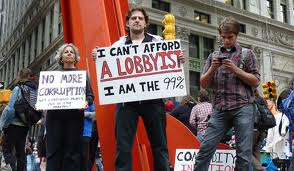
            This outer ring was made up of protesters, most of whom did not appear to be sleeping at the park, with their backs to the park, holding up their signs (especially on the North side of the park, where discarded signs are arranged on the sidewalk), as if projecting their message out into the world. The signs themselves were as varied and diverse as the people holding them.  Some were nonsensical rants against anything from the Illuminati to the Fed, but most demonstrated reasonable, if vague, concerns.  On my first exploratory circuit around the park, I noticed one well dressed man with salt and pepper hair holding an extremely detailed proposal for bank reform.  There was a crowd of people around him, leaning in to read each well thought out line.  Clearly, not everyone at the protest was vague about what they wanted.
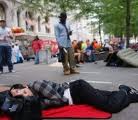
            Beyond the outer ring of protesters with signs (and of course, this wasn’t in any way organized, it just shook out this way, like a centerfuge) can be found the beating heart of OWS.  There were piles of sleeping gear, tables and bins full of donated food, an organized kitchen, Info booth, a booth of professional Life Coaches who had donated their time, a library with a few hundred books to lend, an arts and crafts area for sign making, oh, and a bunch of dirty hippies.
            These are the guys that cable news likes to put forward as representative of the protest – smelly anarchists more interested in smoking weed than social change.  Of course, while they certainly stood out, they were not as large a portion as Fox news would lead you to believe.  Don’t get me wrong, there were some people who smelled as if they’d bathed in sewage, but only a handful among hundreds.  Many were on the young side, as is to be expected in any event that involves sleeping on the cold ground (admit it, ye older generations, it’s not as appealing as it once was), but this was not universal.  Some were unemployed or underemployed, and some (like me) were there on their days off.  It was diverse, chaotic, exciting, and entirely bewildering for the first couple of hours.
            There were lots of sights – musicians jamming, artists drawing, and even a few people trying to meditate despite the constant din.  One rather serious looking yogi sat on a raised area of the park in lotus, chanting a mantra over and over.  I got closer, trying to hear the words, but I only caught “ram” before I was forced to retreat due to the rather forceful odor emanating from him.  I had wondered, before I got close, how he managed to score that nice raised area all to himself, but clearly his scent won it for him.  Clearly, he’s not familiar with the first yogic observance, cleanliness/purity (Shaucha in Sanskrit).          It became clear to me that several of the permanent occupiers were people who may have been on the street anyway, and decided to at least make a statement about it.  Many reminded me of the yearly migrants who camp out in Tomkins Square Park.  But again, they were the minority, but they helped bolster the numbers of those who held the park overnight. 
            That said, I must say again that these folks are 1% of the 99% - they are not representative of the movement at all, but they definitely stand out, to me and to the news crews.  After all, throngs of regular people are much less interesting than anarchist freaks. But it’s the regular people that give the movement it’s passion and strength.
            I spent about an hour taking all this in, walking around, listening to debates, before I finally settled on approaching the coaching booth, to see if they could suggest how I could get involved.  The energy of the place was contagious.
            I probably should mention that what I describe above was rather early in the day, just about noon.  As the day went on, the numbers swelled, and what had been a din rose to a cacophony.  By 5pm the crowd had swelled with people getting off work and students getting out of class.  Like some kind of protoplasmic organism, the protest began to bud smaller groups (of mere hundreds) which marched off elsewhere, chanting slogans and flanked by police.  I couldn’t tell if the march I witnessed was organized or completely impromptu.  I suppose it really doesn’t matter.
            (More Pictures from the Interwebs)

Experiencing Occupy Wall Street

What is Operation Wall St?  Suddenly, the protests in NYC are all over the news and similar “Occupy” movements are popping up all over the country.  People are talking about it online and off, and the two most commonly expressed feelings I’ve seen are of general support for the movement or guarded skepticism and vague complaints about the protesters not having a coherent message.  Do they have a message?  Do they have policy recommendations?  Do they have ideas of how to implement change? 
            I found myself suddenly needing to find out for myself.  I scanned the newspapers, but it the spin was immediately apparent, from the NY Times to Fox.  Perhaps unsurprisingly it was a tech/nerd blog, BoingBoing, that seemed to be the clearest, posting videos, unedited interviews, and various unofficial ‘demands’, many of which were later seized upon by official news channels as the general demands of the movement.  Clearly, there was not one set of demands, nor one group even leading this thing.  My confusion mounted, but I felt moved by what I’d read online, and after the demonstration of the effectiveness of protest and passive resistance that we saw in the “Arab Spring” especially in Egypt, I began to hope.  Could this be the beginning of something bigger?  If so, should I get involved? 
            Of course, the only way to find out what the deal is would be to actually go down there, so that’s what I did.  No, I didn’t camp, I just went down for the day, but part of me wanted to move in.  Another part of me wanted to run home and take a shower.  I was there for the whole afternoon and into the evening, and when I got home I was exhausted.  It was just too much for simple yogi like me to take in.  I reflected, I thought, and I decided I should share my thoughts with you. 
            I’ve divided what I’d originally written up into several parts, as there’s a lot to say, and I’ve only scratched the surface. I’m going to try to describe the facts on the ground first and keep the analysis for later.  My apologies if I can’t keep things too unbiased, as I clearly have strong feelings on this topic. 

Wednesday, March 23, 2011

Government Regulation of Yoga Teacher Training

I want to take a moment to respond to a recent blog post by Darla Magee in the popular yoga blog YogaDork. (Go ahead, read it – It’s short and I’ll wait.) While I often enjoy the light-hearted and occasionally silly posts, this one somewhat irritated me.  It concerns a new initiative by the Texas government to regulate Yoga Teacher Trainings in that state, under the jurisdiction of the Texas Workforce Commission which regulates post-secondary education (post high school, specifically vocational education).  I should note that this government organization specifically exempts dance, physical fitness and martial arts training from their purview, as these are non-vocational – in other words, they are not intending to train you to perform a job.  While clearly teacher trainings can prepare you for working as a teacher trainer, this is not the only reason people undertake them.  Furthermore, not only do many people who go through a training never teach professionally, a significant portion of the training hours usually covers philosophy, spiritual practices, and classic texts which are rarely taught, if ever, in a standard yoga class.

            Magee’s main argument in support of such regulation is that there are yoga teachers out there right now who clearly do not know what they’re doing.  She seems to believe that government regulation will fix this problem, and not only that – she seems to believe that it will help spread yoga to more people.  She writes: “Imagine getting the Federal Government to bring yoga to the military! Imagine getting your health insurance to pay for your classes! Imagine government money and student loans for teacher training! For all of these reasons and so many more, the state’s acknowledgment of yoga opens many doors toward making yoga mainstream, accessible, and affordable to all.”

            Without getting too deeply into the debate about what “yoga” is anyway (is it a spiritual practice and therefore protected from government interference under the Constitution, or is it just Zumba with Indian spice?) I want to point out why Ms. Magee’s view is superficial, economically naïve, and ultimately detrimental to the diversity and spread of yoga. 

            Who really thinks that state bureaucrats are even remotely qualified to regulate yoga?  (Let alone TEXAS state bureaucrats!)  How will they define yoga?  How will they regulate the curriculum?  How can they possibly be in the place to offer any guidance on this ancient tradition? With the abundance of styles, points of emphasis, how is it possible to really regulate such a thing effectively?  Consider meditation alone – is it part of the yoga practice?  If so, how much time should be allocated to it in a 200 hour training?  More importantly, how can a bureaucratic committee, which may not even include a single person with meditation or yoga experience possibly make such a distinction.  It may be fairly argued that the regulations can be kept fluid, much like the Yoga Alliance’s standards, but if that’s the case I don’t see the point of regulation.  After all, the Yoga Alliance has become the de facto industry standard unless laws are passed to make the teaching of yoga illegal without having graduated from a state certified training.  This leads to further complications caused by varying state standards, not to mention the potential embarrassment of the visiting authentic Indian yogis, whose only training may have been at the feet of their (unlicensed) guru, when they are fined for teaching yoga without being “qualified.”  The bag of worms is deep indeed.

            A perhaps more important question is why the State is getting involved anyway?  Have you heard of a spat of recent yoga accidents?  I haven’t.  Sure, there are bad teachers out there, even a few who may be dangerously negligent. But knee-jerk regulation is not the way to go.  Bad teachers, like bad anything else, will soon find themselves moving on to another line of work.  A few bad apples should not require that the government should inspect every apple tree.  Are state bureaucrats such passionate yogis themselves that they really care about making sure that yoga is properly taught?  Clearly not.  But if you look at what regulation of yoga schools actually means, the motivation becomes clear:  it allows the state to charge licensing fees to yoga studios who offer teacher training programs. 
 
            I have to assume that the financial factor is what Ms. Magee meant when she said she was “bowing out and taking my money with me once I got a look at the real motives of those who are most loudly protesting”.  Clearly this writer was absolutely disgusted with the fact that studio owners might protest that their bottom line was adversely affected by the regulation.  Oh, those greedy yoga studios, always out to make a buck! As the owner of a small yoga studio in a small town, let me tell you that a teacher training program is financially a godsend, and in many cases is the difference between subsistence living and being able to pay off the debts incurred by opening the studio to begin with, not to mention the possibility of expansion.  And by expansion I don’t mean lavish new facilities, but the addition of classes, and yes, the hiring of yoga teachers other than the owners.  When New York tried to regulate training programs (and thankfully backed down), what it meant for my small business was that we would not be able to afford licensing (in New York, the proposed application fee was $5,000), and therefore we would not be able to afford to offer a program. I ask Ms. Magee – is it bad to want to be able to pay one’s bills, to make a living doing what one loves, to want to share yoga at the deeper level of a teacher training, and to do so independently?   I can also say that, as a business owner, if I can’t support my family through my business, I can’t hire other yoga teachers either.  That cuts down on the diversity of voices in the community, as well as the ability of individual yoga teachers to support themselves.  Sure, there’s gyms, but any experienced yogi can tell you the differences between a yoga class held at a gym, where philosophy and spirituality is often discouraged by the owners, and a class at a dedicated studio space which offers a different level of freedom to teachers. 

            The costs of regulation on small businesses might also mean that only the largest, big-name studios would be able to afford to train yogis.  Perhaps this is what Magee wants when she writes about wanting yoga to enter the mainstream.  But to me, this means the further branding of yoga, and the consolidation of yoga under certain companies and/or teachers.  As the largest studios are in the cities, it also means that one would have to be near a major city to complete a training.  Of course, the market will eventually adjust, and with the further concentration of revenue in the large studios, franchises offering training (under the same license as the main studio) might appear in small towns.  I would predict that this will make it harder for small businesses like mine, and may even drive up the cost of yoga in some areas. 

            Magee’s main argument in support of regulation is that it is equivalent to the state “recognizing” yoga, as if such a thing is needed.  She wants insurance companies to cover yoga, and student loans for trainings, etc.  A noble goal, certainly, but one which state governments do not have the power (or the interest) to enact.  New York State regulates Massage Therapy more strictly than just about any other state, and there are national standards as well.  Yet most insurance carriers still do not cover massage therapy.  Certainly, massage therapy is “recognized” by the government, and is possibly more accepted by physicians than yoga, but its recognition has done little to change the private sector, although it clearly generates revenue for the state.  This directly affects the cost of training, as the school must pay licensing fees on top of other expenses.  Different standards by state also means that tuition fluctuates wildly.  In Texas, for instance, the price of the 500 hr massage therapy training averages around $5000, while in New York, with its 1000 hr training can be over $20,000.  Ultimately, regulation does not make this practice more accessible, nor does it bring yoga into the light of mainstream awareness – yoga is already mainstream!  What it does do is streamline yoga, reducing diversity and intellectual (and spiritual) freedom by transferring control from the teachers and representatives of the tradition, who have an important stake in the discipline, to the state, which ultimately only cares about yoga for its potential revenue.  Yes, I'm aware that the state is only regulating trainings, not classes, but for a yoga teacher, what experience is more formative than a teacher training?

            I recognize that the Yoga Alliance often seems to have its head up its ass.  Regardless, they have successfully set the standard for 200 and 500 hr trainings, and I believe they are doing good thereby.  Yet even within Yoga Alliance certified trainings there is a tremendous variance of quality.  My studio’s training far exceeds  the minimum standards of the Yoga Alliance in terms of hours, as well as the rigor of the program.  I’ve also heard horror stories of some really, really bad teacher training programs which happen to be certified.  This is clearly a case of “buyer beware.”  Do your research before you throw down your hard-earned cash for a training – I did, and got exactly what I was looking for. 

            Regulation, in order to represent the diversity inherent in the yoga tradition, would substantially be no different than the Yoga Alliance, with the same flaws and problems.  The only difference would be the level of expense and its subsequent impact on small businesses, studio-contracted yoga teachers, and potential teachers looking for an affordable training.  Whatever qualitative problems may exist among yoga teachers, state regulation is clearly not the answer.